Appearance

Surveying revetment: preparation and installation advice

Want to build or replace revetment? Start with measurements and photos of your waterfront. There is no universal panel length or post spacing. Soil, retained height, water level and load determine the construction together. DamwandDirect supplies products and checks enquiries; installation, structural design and permits are not automatically included.

Prepare your project

How to record useful site measurements

First choose a fixed, recognisable reference point and record it as 0.00 m. Measure every level relative to that same point, using positive and negative signs. Measure only from a stable, accessible place; have a contractor record missing or hard-to-reach details.

Completed sketch example — illustration only

All dimensions, angles and levels below are invented to show how to record information. This is not a design, recommended sizing or guidance for post length, spacing or embedment. The sketch is not to scale.

Plan view: A–B 6.00 m; B–C 2.50 m; Corner B: 90° (example)Land sideWater sideABC6.00 m2.50 mR = 0.00 mCorner B: 90° (example)Alignment A–B–C
Plan view
Cross-section at B. Fixed reference point R: 0.00 m. Ground level: +0.40 m. Known high water: +0.10 m. Measured water: −0.20 m. Known low water: −0.50 m. Waterbed: −1.00 m. No structural depth shown.R: 0.00 mGround level: +0.40 mKnown high water: +0.10 mMeasured water: −0.20 mKnown low water: −0.50 mWaterbed: −1.00 mNo structural depth shown
Cross-section at B

EXAMPLE — NOT A DESIGN

  • Fixed reference point R: 0.00 m
  • Ground level: +0.40 m
  • Known high water: +0.10 m
  • Measured water: −0.20 m
  • Known low water: −0.50 m
  • Waterbed: −1.00 m
  1. Alignment: straight lengths, corners, angles and connections; label each section.
  2. Reference: identifiable fixed point, date, measuring method and all heights in the same unit.
  3. Cross-section: ground level, waterbed and measured water level; known high/low water with source and date.
  4. Soil: known layers and information source; write unknown if there has been no investigation.
  5. Loads: terrace, storage, traffic or building with distance from the bank and planned changes.
  6. Access: clear opening, route, working space and how long components can reach the site.
  7. Photos: overview, both ends, corners, cross-section and details; match filenames to the sketch.

Open the downloaded HTML file to print it or save it as a PDF using the print function. The download contains your entries and works offline.

Short answer

Can I install Prolock revetment myself?

You can collect measurements, photos and a site sketch yourself. Profextru describes revetment installation as precise, complex work requiring experience and skill. Lightweight panels make handling easier, but do not determine whether you can design and install the complete construction yourself.

Before ordering, agree who assesses the structure, who carries out installation and who checks the required consent. Request the appropriate installation manual for the selected variant and have the contractor use it alongside the project design.

Include these project details

Clear measurements and photos help us assess whether the selected panels, posts and finishing form a sensible materials list.

  • Total bank length, straight sections, curves and corners
  • Retained height and water level on both sides
  • Known soil conditions and loading behind the bank
  • Photos of the bank, surroundings and existing construction
  • Access, desired timing and collection or delivery

Add a cross-section: draw the land side, water side, ground level, soil and water level with known heights. Note the reference point for each height so it is clear what you are measuring from. Profextru uses a completed cross-section for an indicative strength calculation. Record missing soil or level information as open assessment issues.

Read the preparation requested by the manufacturer (Dutch)

Send project details
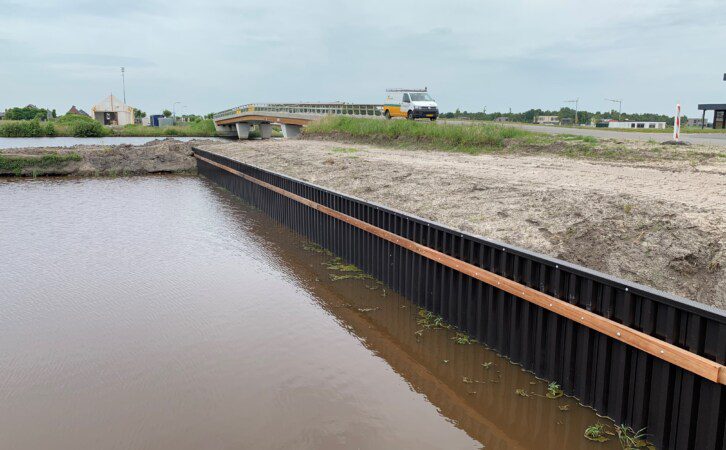
Completed Prolock Sigma revetment along a waterfront

When is a calculation needed?

Greater retained height, heavy loads, traffic close behind the bank, poor or unknown soil, anchoring or complex connections require project-specific structural assessment. Product advice or a webshop calculation does not replace it.

Install safely and carefully

For machine excavation in the Netherlands, submit the required KLIC notification beforehand and use the received cable and pipeline information at the excavation site. Also check site stability and use equipment suited to component length and weight.

Permit, notification or consent

Work on a bank or watercourse may need consent, notification or a permit from the municipality, water authority or another manager. Check before ordering and installation through the Dutch Omgevingsloket and responsible water authority; rules vary by location.

Follow the permit and notification steps

Frequently asked questions

What can you determine yourself in advance?

What post spacing should I use for revetment?

There is no safe universal dimension. Post spacing and cross-section depend on soil, retained height, water level, surcharge, board or panel type and any anchoring.

How deeply must sheet piling or a revetment post enter the ground?

Required embedment depth follows from soil conditions and the forces on the structure. Visible height or water depth alone is therefore insufficient to select panel or post length.

Can I calculate how much material I need myself?

You can record route length, corners and quantities in advance. Then have it checked whether working widths, connections, cutting waste, posts, walers, fixings and finishing together form a complete list.

Do I need a permit for revetment or sheet piling?

This differs by location and water authority. Before ordering, check through the Dutch Omgevingsloket and with the municipality or water authority whether a permit, notification or separate consent is needed.
Explore further

Combine installation questions with systems and costs

An installation plan starts with the same project details as system selection and budgeting. Use the knowledge guides to compare the options.

From situation to materials list

Align system, dimensions and installation

A panel can function properly only if posts, walers, connections and any anchoring can resist the same loads. Also check connections to existing banks, ends and height transitions. If in doubt, consult a structural engineer or experienced contractor before ordering.

View product groups

Check threaded rods and washers as part of the connection

The PGB DIN 975/976 threaded rod and DIN 125A flat washer in A2 stainless steel have separate dimensional and material specifications. For each selected variant, check diameter, strength, connection and corrosion environment. These product names alone do not form a suitable combination or anchoring recommendation for a permanently wet construction.

Also include mating bolts or nuts, pressure distribution on the timber and any anchoring in the materials list. Have the complete connection assessed for the same loads as the posts and walers.

Compare panels, posts and walers

Working on the garden around your waterfront too?

A boundary fence beside the revetment

Looking for more privacy in the garden beside the bank? Betonschuttingshop offers advice on concrete fencing in Dutch. A fence marks a boundary; it is not an earth-retaining revetment. Have its position and load near the bank included in the structural assessment.

Finishing above-ground garden timber

For finishes on a timber garden screen or garden furniture above the waterline, you can use the Beitsenkwast product selector in Dutch. Always check timber species, existing finish and permitted use in the product data sheet. This is not advice for permanently submerged timber; stain or oil does not replace structural protection of the bank either.

Verifiable sources

Sources for this page

The links below support the factual information. Manufacturer sources remain clearly identified; check local rules with the competent authority. Linked external original sources are in Dutch and government sources concern the Netherlands.